
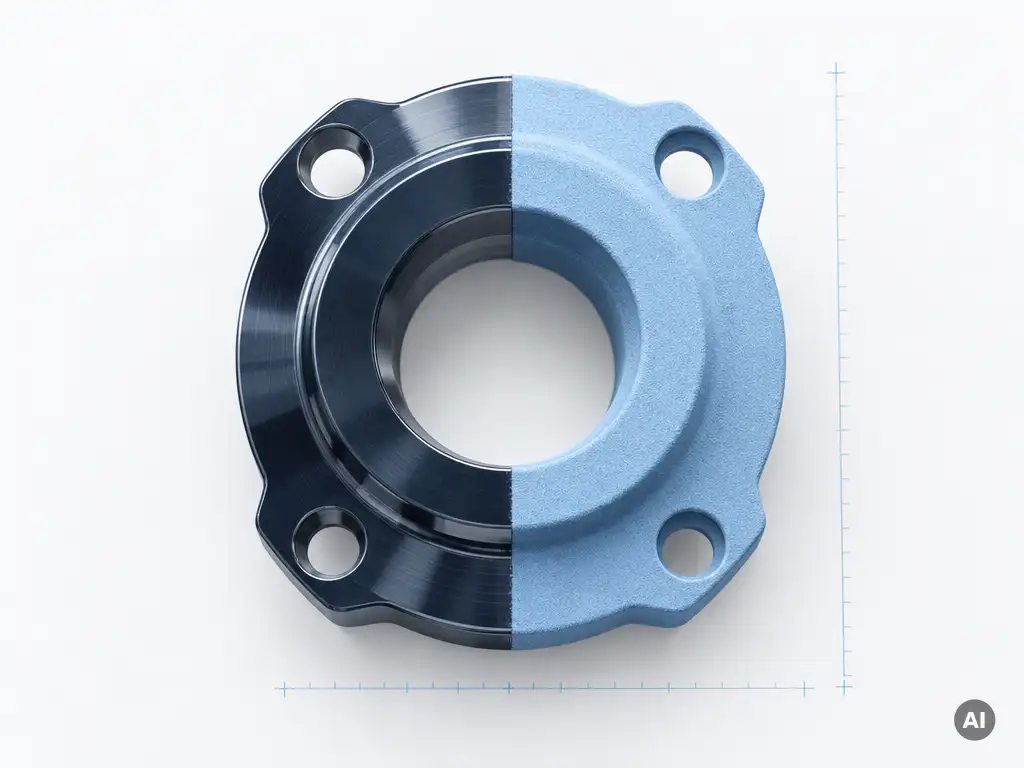
A 3D scanning spray is a thin, matte coating that you apply to a surface so an optical scanner can capture its geometry accurately. It is needed when an object is shiny, transparent, dark or reflective, because these surfaces bounce or absorb light unpredictably. A vanishing scanning spray does this job and then disappears on its own.
Optical scanners depend on clean, diffuse light reflection to calculate coordinates. Whenever a surface fails to provide that, you get noise, holes and rescans. The sections below explain how these sprays work, when you need one, and how to pick the right type.
How does a sublimating scanning spray work on a surface?
A sublimating scanning spray deposits a thin, white, matte layer that turns directly from a solid into a gas without becoming liquid. While the layer is present, the scanner sees a uniform, diffusely reflecting surface. Once scanning is finished, the coating evaporates by itself, so you do not need to clean the part.
The process has three stages. First, the propellant and solvent carry the active coating to the surface and evaporate within seconds. Second, a dry, white layer remains, and this is the layer your scanner measures. Third, the coating sublimates over a period of hours, depending on the formulation.
This differs from conventional powder-based sprays, which leave residue that you wipe, brush or rinse away. Residue can contaminate sensitive components, your scanner and your workspace. Pigment-free sublimating formulas avoid that problem, which matters for clean production environments and laboratories. Check each product’s data sheet, though, because not every spray in the category has the same composition.
Which surfaces and scanning situations require a scanning spray?
You need a scanning spray whenever a surface prevents the scanner from receiving a clean, diffuse reflection. This applies mainly to transparent, reflective and dark parts, and to deep pockets where light scatters between walls. Optical scanners need light to return from the surface, and these materials interfere with that.
Here is how each situation affects your data:
- Transparent parts: Light passes through glass or clear plastic, so the scanner cannot detect the actual surface.
- Reflective and glossy parts: Polished metal or mirror-like finishes bounce light away in focused beams, which leaves gaps or spikes in the point cloud.
- Dark or black parts: These surfaces absorb light, which weakens the signal and increases noise.
- Deep pockets and fine edges: Light reflects from the walls onto the bottom of the cavity. These secondary reflections create noisy, unreliable data.
- Mixed surfaces: Different colors, textures and gloss levels on one part produce inconsistent measurements. A uniform matte coating gives the scanner consistent conditions.
Not every scan needs a spray. Matte, light-colored parts with clear geometry often scan well without any preparation. If you are unsure, run a short test scan first and look for holes, noise and outliers before you decide.
How thick is the coating, and will it affect tolerances?
Scanning sprays typically form layers in the single-digit to low double-digit micrometer range. Depending on the product, this can be roughly 2 to 15 µm. For most applications, that is thin enough to leave tolerances unaffected, but for very tight tolerances you should account for the layer thickness.
Layer thickness varies by product and by how you spray. A thin, even coat gives the best results, so apply only as much as you need to achieve full matte coverage. Spraying thicker than necessary adds material without improving data quality.
When you work to tight tolerances, consider these points:
- Check the stated layer thickness on the technical data sheet for your chosen product.
- Keep your application consistent. Uniform spray distance and stroke speed produce a more homogeneous coating, and uneven buildup is a bigger risk to accuracy than the nominal thickness itself.
- If your process requires it, compare a coated and an uncoated reference feature to quantify the offset in your own setup.
What is the difference between sublimating and permanent scanning sprays?
A sublimating scanning spray vanishes on its own after a set time, while a permanent scanning spray stays on the surface until you remove it. The main difference is what happens after the scan: sublimating coatings need no cleaning, whereas permanent coatings require rinsing or wiping.
Sublimating (vanishing) sprays
These coatings evaporate over hours, which removes the cleanup step and leaves the part untouched. They suit routine scanning, delicate or high-value parts, automated workflows and any case where residue is a concern. The trade-off is a limited working window. You must finish scanning before the coating disappears, and scanning time and sublimation time vary by product.
Permanent sprays
A permanent coating does not disappear, so it supports long scanning sessions or repeated scans over days. You accept a cleaning step afterward. This option makes sense when the part tolerates cleaning and you need a stable, high-contrast white surface for a long period.
Choose based on your workflow. If time per part and part cleanliness matter most, a vanishing scanning spray usually fits better. If you need long-term stability and cleaning is acceptable, a permanent coating can be the more practical option.
How do you choose and apply the right scanning spray?
Choose a scanning spray by matching three things to your job: how long you need to scan, how thin the coating must be, and whether the coating should vanish or stay. Then apply a thin, even layer from a consistent distance, and test on an inconspicuous area first if the surface is sensitive.
Choosing the right spray
Work through these questions in order:
- How long will scanning take? Short sessions suit a faster-vanishing coating. Longer sessions need a product with a longer scanning window.
- How thin must the layer be? For fine details or tight tolerances, pick a formulation with a lower layer thickness.
- Should the coating disappear? If cleaning is undesirable, choose a sublimating spray. If not, a permanent coating works.
- Does color matter? For photogrammetry or color capture, a transparent vanishing coating preserves the object’s visible color information.
- What is the object size? Aerosol cans suit quick, manual jobs. For large parts or automated, robot-guided scanning, a liquid applied with a spray gun gives you more controlled and repeatable coverage.
The right product depends on the surface and your application, not on your scanner brand. Sprays work with common optical systems, including laser, structured light and photogrammetry setups.
Applying it correctly
- Spray from the distance given in the product instructions, using even strokes.
- Apply as thinly as possible while still achieving full matte coverage.
- Ensure good ventilation and follow the safety data sheet, since aerosols contain flammable propellants and solvents.
- Place reference points before or after coating as your workflow requires. They improve alignment on large parts and on objects with few geometric features, and an irregular pattern is easier for the scanner to identify than a regular grid.
Which scanning spray solutions does AESUB offer?
If you want to prepare difficult surfaces without cleanup, we can help you select and apply the right coating. Our AESUB scanning sprays cover different scanning times, layer thicknesses and applications, so you can match the product to your part instead of compromising.
- Sublimating sprays for different scan durations: AESUB blue is our general-purpose option for shorter sessions, AESUB orange creates an especially thin coating, and AESUB violet offers a longer scanning window.
- Color preservation: AESUB transparent is a vanishing clear coating for applications where visible color information matters.
- Permanent coating: AESUB white does not sublimate and rinses off easily when you need a stable surface over a longer period.
- Large parts and automation: AESUB green is applied with a spray gun and suits large objects and robot-guided scanning.
- Alignment and repeatability: Reference points, measuring frames and magnetic measuring cubes support accurate stitching of individual scans.
Each product has its own specifications, so check the technical data sheet for your application. If you want advice on which spray fits your surface and scanner, get in touch with our team.